I designed my virtual field trip in Google Earth in consideration of all of the five minds for the future Garner describes. My virtual field trip is one that takes 8th grade students to different parts of the United States and a Native American group is explored on at each place mark. I designed my virtual field trip in Google Earth in consideration of all of the five minds for the future Gardner describes. This course has made me conscious of the importance of nurturing and developing a disciplined mind, a synthesizing mind, a creating mind, a respectful mind and an ethical mind in my students. A lesson or activity that can encompass all of these, and in equal parts, is the ideal. However, Gardner reminds us that, “There is no legitimate reason why the cultivation of one kind of mind should preclude the cultivation of others.” I think most lessons or activities will lean more heavily to one or two of these minds, but all must be included. In creating my project in Google Earth I focused more heavily on the respectful mind and the ethical mind.
The goal of my project was to provide students with a perspective on the different people and cultures that first inhabited this continent. In this way I hope to foster a respectful mind. The respectful mind has awareness of and appreciation for differences among human beings and human groups. I originally planned to create a virtual field trip of aboriginal peoples all over the world. However, I soon realized that the scope of this project seemed too broad. I also realized that I was focusing too much on the disciplined mind, thinking only of having students learn geography, history and facts about other countries. I changed my topic because Native Americans are a group that is a subculture within the United States, but their contributions to our history and society are greatly overlooked. I felt that it is important that students be shown that distance is not necessarily the only obstacle to understanding and respecting other cultures, lifestyles, beliefs and traditions. I also wanted students to develop an understanding that proximity does not always lead to assimilation of cultures. Students begin and end their virtual field trip in Northeastern Pennsylvania, an area familiar to them. I felt this was important to create the impression that they need to bring what they have learned about others back to their own backyard, so to speak.
The first place mark on the trip was to New York and the Iroquois Nations. This area is geographically close to their home area. Again, I felt this was important to give students the sense that Native peoples inhabited all areas of North America. I also felt that focusing the video on how the Iroquois lived, their homes, their clothing, their family ties was important. Students could then compare and contrast the lifestyles of the ancient Iroquois to their own ancestors and to their lives today.
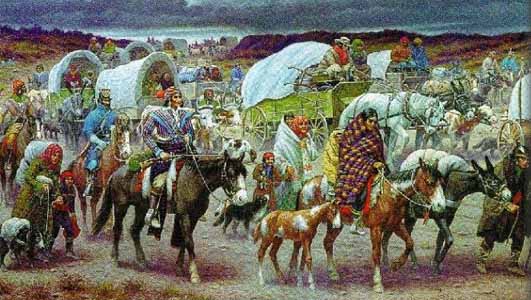
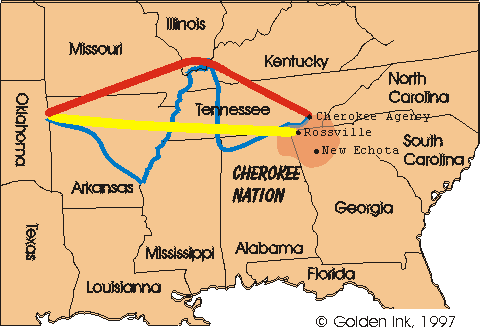
The Plains Indians place mark shows the rich heritage and traditions of the Great Plains hunters. Although the video concentrates on the tribes of the Plains, the image included also shows the art of these people and how they passed down their history from generation to generation. Students can learn more about the Battle of Little Big Horn and the Native perspective as opposed to the white settlers’ perspective presented in the majority of media presentations. The next place mark was created in South Carolina. Here begins the historic, “Trail of Tears”, of the forced march of the Cherokee to the Oklahoma territory. Here students learn about how intolerance of cultural differences and an imbalance of power can result in disrespect and unethical behavior. I was inspired to include this place mark by Gardner’s words, “The task for educators becomes clear: if we are to fashion persons who respect differences, we need to provide models and offer lessons that encourage such a sympathetic stance. Such modeling is especially crucial when the power relationships between individuals or groups appear to be asymmetrical.” For the writing prompt, I required students to explore their feelings about the plight of the Cherokee from their perspective. The photo image placed here included a map of the route the Cherokee were forced to March and the students are prompted to use the layering tools in Google Earth to explore the terrain and climates of the states and territories they passed through.
The Southwest place mark explores the ancient Anasazi culture. Here my goal was to impress upon students how long Native Americans were present on the continent. Many students believe that the history of North America begins with European colonization. By exposing to students to the ancient history of the Anasazi, they can begin to change their perspective about their sense of being Americans and Natives being a “foreign” culture. I also included an image of Kokopelli so that they could understand the sense of play and lightheartedness of Native peoples. The images students see in the media often portray Natives as savage and dull. The image also provides a link so students can hear Native American flute music. Flute like instruments exist in some form in almost every culture and students may be able to relate this to other cultures they have studied.
The Northwest place mark was included because, of all the Native American tribes, those of the Northwest are the least known. I included an image of a Totem pole, probably the most well-known image from these native peoples, but included a link to a website that explained their symbolism well and dispelled the myths that have perpetuated over the centuries in classrooms. The Northwest Native tribes used Totem poles to make a statement of their heritage, their accomplishments and their status in the community.
The last stop on my virtual field trip of Native American history was back in Northeastern Pennsylvania. I chose to focus this place mark on modern day Native Americans. The image included shows a casino, but the content explains that Natives live very much the same way other Americans live today. Here I wanted to focus more on the similarities between Native Americans and all other Americans while still spotlighting the uniqueness of their culture. The writing assignment asks the students to synthesize much of what they have learned and create a writing project that will reflect their respect for the Native American culture. I think this assignment asked students to form opinions about others different from themselves and to recognize their responsibilities to others in their global community.
Native American Virtual Field Trip
Project 3 resources:
Battle of little big horn/wooden leg. [Web]. Retrieved from http://www.nps.gov/libi/images/BattleLBHwoodenleg.jpg
Crestwood high school. [Web]. Retrieved from http://home.epix.net/~captclint/CRESTWD2.JPG
Discovery Education. (2006).People of the Long House: The Iroquois [Video Segment]. Available from http://www.discoveryeducation.com/
Lindneux, R. (Artist). Trail of tears. [Web]. Retrieved from http://www.crystalinks.com/cherokeetrailtears.gif
First nations totem pole alert bay British Columbia. [Web]. Retrieved from http://t2.gstatic.com/images?q=tbn:ANd9GcQ4QhZFps3W2N8u3IGPZ3dNEvjS-0yTmjUiRlppU7dpfRah8sYwxg
Gardner, H. (2006). Five minds for the future. Harvard Business Press.
Golden Ink, Initials. (Producer). (1997). Trail of tears route map. [Web]. Retrieved from http://www.legendsofamerica.com/photos-missouri/TrailofTearsMap.gif
Golden Ink, Initials. (Producer). (1997). Trail of tears route map. [Web]. Retrieved from http://www.legendsofamerica.com/photos-missouri/TrailofTearsMap.gif
Lagan, . (Producer). Utah photo - the kokopelli a romantic flute player from the Anasazi folklore. [Web]. Retrieved from http://travel.sulekha.com/united-states/utah/photos/the-kokopelli-a-romantic-flute-player-from-the-anasazi-folklore-lord-krishna-anyone-petroglyphs-at-the-edge-of-the-cedars.jpg
National Museum of the American Indian, Initials. (Producer). Moccasins. [Web]. Retrieved from http://americanindian.si.edu/searchcollections/multimedia/4142/779/15.350x350.jpg
National Museum of the American Indian. http://www.americanindian.si.edu/Peter Matulavich Productions. (2004).Native Americans: People of the Desert [Full Video]. Available from http://www.discoveryeducation.com/
Peter Matulavich Productions. (2004).Native Americans: People of the Northwest Coast [Full Video]. Available from http://www.discoveryeducation.com/
Peter Matulavich Productions. (2004).Native Americans: People of the Plains [Full Video]. Available from http://www.discoveryeducation.com/
Peter Matulavich Productions. (2007).Native Americans: Native Americans Today [Full Video]. Available from http://www.discoveryeducation.com
Retrieved from http://t3.gstatic.com/images?q=tbn:ANd9GcSjru3zNuv_PE3cn1LYSG6DqhLH6e7SyS47QrgdANEsSrMnMM5h
Wooden Leg. (2010, November 15). In Wikipedia, The Free Encyclopedia. Retrieved 18:32, December 1, 2010, from http://en.wikipedia.org/w/index.php?title=Wooden_Leg&oldid=396972512