Wednesday, December 1, 2010

EDIM508 Project 3 - Google Earth Virtual Field Trip

I designed my virtual field trip in Google Earth in consideration of all of the five minds for the future Garner describes.  My virtual field trip is one that takes 8th grade students to different parts of the United States and a Native American group is explored on at each place mark.  I designed my virtual field trip in Google Earth in consideration of all of the five minds for the future Gardner describes.    This course has made me conscious of the importance of nurturing and developing a disciplined mind, a synthesizing mind, a creating mind, a respectful mind and an ethical mind in my students.  A lesson or activity that can encompass all of these, and in equal parts, is the ideal.  However, Gardner reminds us that, “There is no legitimate reason why the cultivation of one kind of mind should preclude the cultivation of others.”  I think most lessons or activities will lean more heavily to one or two of these minds, but all must be included. In creating my project in Google Earth I focused more heavily on the respectful mind and the ethical mind.
The goal of my project was to provide students with a perspective on the different people and cultures that first inhabited this continent.  In this way I hope to foster a respectful mind.  The respectful mind has awareness of and appreciation for differences among human beings and human groups.  I originally planned to create a virtual field trip of aboriginal peoples all over the world.  However, I soon realized that the scope of this project seemed too broad.  I also realized that I was focusing too much on the disciplined mind, thinking only of having students learn geography, history and facts about other countries.  I changed my topic because Native Americans are a group that is a subculture within the United States, but their contributions to our history and society are greatly overlooked. I felt that it is important that students be shown that distance is not necessarily the only obstacle to understanding and respecting other cultures, lifestyles, beliefs and traditions. I also wanted students to develop an understanding that proximity does not always lead to assimilation of cultures. Students begin and end their virtual field trip in Northeastern Pennsylvania, an area familiar to them.  I felt this was important to create the impression that they need to bring what they have learned about others back to their own backyard, so to speak.
The first place mark on the trip was to New York and the Iroquois Nations.  This area is geographically close to their home area.   Again, I felt this was important to give students the sense that Native peoples inhabited all areas of North America.  I also felt that focusing the video on how the Iroquois lived, their homes, their clothing, their family ties was important. Students could then compare and contrast the lifestyles of the ancient Iroquois to their own ancestors and to their lives today.
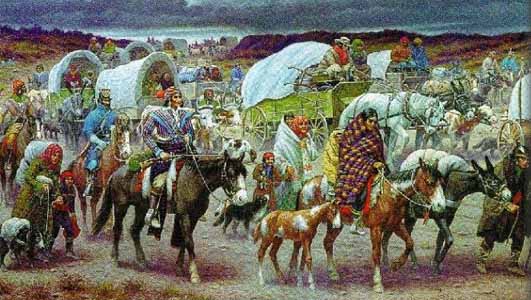
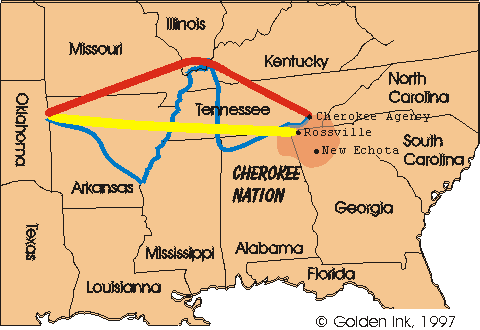
The Plains Indians place mark shows the rich heritage and traditions of the Great Plains hunters.  Although the video concentrates on the tribes of the Plains, the image included also shows the art of these people and how they passed down their history from generation to generation.  Students can learn more about the Battle of Little Big Horn and the Native perspective as opposed to the white settlers’ perspective presented in the majority of media presentations. The next place mark was created in South Carolina.  Here begins the historic, “Trail of Tears”, of the forced march of the Cherokee to the Oklahoma territory.  Here students learn about how intolerance of cultural differences and an imbalance of power can result in disrespect and unethical behavior.  I was inspired to include this place mark by Gardner’s words, “The task for educators becomes clear: if we are to fashion persons who respect differences, we need to provide models and offer lessons that encourage such a sympathetic stance. Such modeling is especially crucial when the power relationships between individuals or groups appear to be asymmetrical.”  For the writing prompt, I required students to explore their feelings about the plight of the Cherokee from their perspective.  The photo image placed here included a map of the route the Cherokee were forced to March and the students are prompted to use the layering tools in Google Earth to explore the terrain and climates of the states and territories they passed through.
The Southwest place mark explores the ancient Anasazi culture.  Here my goal was to impress upon students how long Native Americans were present on the continent.  Many students believe that the history of North America begins with European colonization.  By exposing to students to the ancient history of the Anasazi, they can begin to change their perspective about their sense of being Americans and Natives being a “foreign” culture.  I also included an image of Kokopelli so that they could understand the sense of play and lightheartedness of Native peoples.  The images students see in the media often portray Natives as savage and dull.  The image also provides a link so students can hear Native American flute music.  Flute like instruments exist in some form in almost every culture and students may be able to relate this to other cultures they have studied.
The Northwest place mark was included because, of all the Native American tribes, those of the Northwest are the least known.  I included an image of a Totem pole, probably the most well-known image from these native peoples, but included a link to a website that explained their symbolism well and dispelled the myths that have perpetuated over the centuries in classrooms.  The Northwest Native tribes used Totem poles to make a statement of their heritage, their accomplishments and their status in the community.  
The last stop on my virtual field trip of Native American history was back in Northeastern Pennsylvania.  I chose to focus this place mark on modern day Native Americans.  The image included shows a casino, but the content explains that Natives live very much the same way other Americans live today.  Here I wanted to focus more on the similarities between Native Americans and all other Americans while still spotlighting the uniqueness of their culture.  The writing assignment asks the students to synthesize much of what they have learned and create a writing project that will reflect their respect for the Native American culture.  I think this assignment asked students to form opinions about others different from themselves and to recognize their responsibilities to others in their global community. 

 
Native American Virtual Field Trip


Project 3 resources:
Battle of little big horn/wooden leg. [Web]. Retrieved from http://www.nps.gov/libi/images/BattleLBHwoodenleg.jpg
Crestwood high school. [Web]. Retrieved from http://home.epix.net/~captclint/CRESTWD2.JPG
Discovery Education. (2006).People of the Long House: The Iroquois [Video Segment]. Available from http://www.discoveryeducation.com/
Lindneux, R. (Artist). Trail of tears. [Web]. Retrieved from http://www.crystalinks.com/cherokeetrailtears.gif
First nations totem pole alert bay British Columbia. [Web]. Retrieved from http://t2.gstatic.com/images?q=tbn:ANd9GcQ4QhZFps3W2N8u3IGPZ3dNEvjS-0yTmjUiRlppU7dpfRah8sYwxg
Gardner, H. (2006). Five minds for the future. Harvard Business Press.
Golden Ink, Initials. (Producer). (1997). Trail of tears route map. [Web]. Retrieved from http://www.legendsofamerica.com/photos-missouri/TrailofTearsMap.gif
Lagan, . (Producer). Utah photo - the kokopelli a romantic flute player from the Anasazi folklore. [Web]. Retrieved from http://travel.sulekha.com/united-states/utah/photos/the-kokopelli-a-romantic-flute-player-from-the-anasazi-folklore-lord-krishna-anyone-petroglyphs-at-the-edge-of-the-cedars.jpg
National Museum of the American Indian, Initials. (Producer). Moccasins. [Web]. Retrieved from http://americanindian.si.edu/searchcollections/multimedia/4142/779/15.350x350.jpg
National Museum of the American Indian. http://www.americanindian.si.edu/Peter Matulavich Productions. (2004).Native Americans: People of the Desert [Full Video]. Available from http://www.discoveryeducation.com/
Peter Matulavich Productions. (2004).Native Americans: People of the Northwest Coast [Full Video]. Available from http://www.discoveryeducation.com/
Peter Matulavich Productions. (2004).Native Americans: People of the Plains [Full Video]. Available from http://www.discoveryeducation.com/
Peter Matulavich Productions. (2007).Native Americans: Native Americans Today [Full Video]. Available from http://www.discoveryeducation.com
Wooden Leg. (2010, November 15). In Wikipedia, The Free Encyclopedia. Retrieved 18:32, December 1, 2010, from http://en.wikipedia.org/w/index.php?title=Wooden_Leg&oldid=396972512

Tuesday, November 30, 2010

(u07a1) Blog on Developing Your Five Minds

The blog that I subscribe to is the Educational Technology Blog located at : http://www.educationtechnologyblog.com/
I subscribe to this blog because it helps me to stay abreast of all the most recent web 2.0 tools and how to use them in education.  I find that this blog helps me in my discipline, education, specifically online education.  It also helps to nurture my creating mind by giving me advice from experts and modeling ways in which these tools are used by others.  I like the informal atmosphere of the blog and I like being able to comment and share my experiences by leaving comments without fear of reproach..  Not all of the information presented in the blog is for online educators, in fact most of it is for classroom teachers.  However, I am able to synthesize the various skills and resources and adapt and modify them so that I can use them for online teaching and to present them to my faculty.  The best part of this blog is not the original postings but the comments that come in from educators around the globe.  Through these comments I am able to gain new and different perspectives on how other educators are using these same resources in their traditional and virtual classrooms, and I am able to share my perspectives with them.

Gardner, H. (2006). Five minds for the future. Harvard Business Press.

Cultivating the Respectful and Ethical through the use of technology

From educators to entrepreneurs to journalists, the consensus is that were a quickly becoming a global community and our students need to be prepared to live and thrive in this community.  Gardner tells us that to be successful in this global age we must develop minds that are respectful and ethical.  A respectful and ethical mind shows tolerance and understanding of others cultures and belief systems and fosters collaboration between individuals and groups. Julene Reed offers several different ways in which educators can use digital media to begin to develop the skills they need to nurture respectful and ethical minds and eventually prosper in this new global community.  Ms Reed lists several examples of web 2.0 tools that can be utilized for this purpose.  One that she does not mention are virtual learning environments.
Through virtual 3D learning environments, students can take virtual field trips, work collaboratively with students all over the world and accept others on their character, abilities and behavior instead of appearance or lifestyles.  One such virtual world is Zon.  Zon is a massively multiplayer online role-playing game (MMORPG).In this virtual environment, students arrive in virtual Beijing at a train station and must use their Chinese language skills to navigate through the city.  Students who participate in this "game" learn about Chinese culture, Chinese language and they experience being a tourist in a foreign country.  Students create avatars and they use audio tools to speak to others within the game.  This is a wonderful way to learn technology skills, learn about other cultures and languages and learn how to work collaboratively with others.  The game has rules for proper and respectful behavior as well.


Resources:

http://www.experiencechinese.com/index.php/products/zon
Gardner, H. (2006). Five minds for the future. Harvard Business Press.
http://www.edtechmag.com/k12/events/updates/global-collaboration-and-learning-2.html

Friday, November 19, 2010

EDIM 508 transue Project2: Glog

I created my Glog around the theme of digital media resources for teachers.  I supervise 60+ online social studies teachers.  Although my teachers instruct using digital media.  They are often just as unaware or intimidated by digital media as any brick and mortar teacher.  The courses they teach are created by our curriculum department.  The courses have a lot of interactive media within them,  However, they are designed to provide students with solid foundation that teachers enhance with supportive instruction and resources.  I have found that many of my teachers are hesitant to use other media sources to instruct their students.  I believe there are several reasons for this phenomenon.
The teachers who seem to be the most adventurous and creative when it comes to using digital media are those who are new to teaching.  The inexperienced teachers have first hand experience using digital media in their personnel lives and in the course of their under graduate studies.  Some of my veteran teachers may be experienced in traditional teaching and online teaching but they have not grown up with the technology.  The more experienced, more mature teachers are "digital immigrants" compared to the less experienced teachers who are "digital natives"  I think this is a big factor in a teacher's desire and level of comfort in using digital media to instruct.  Experienced teachers may be concerned with the possibility that they may not be able to master the media tools and they fear failure.  The less experienced teacher is willing to be more adventurous with the media tools because they are less worried about their reputation should they fail. The older teachers may have the polished digital media examples in their course content, but that was created by expert curriculum writers.  The teacher is not privy to the process or processes that were taken to achieve the finished product.  They may even be intimidated by it.  The less experienced teachers are more accustomed to researching new ideas and techniques on the Internet and they seek out expert advise on incorporating media into their instructional practices from experts on various web sites including YouTube, Google, Wikipedia and a myriad of others.  The teachers who are less experienced at teaching are the first to volunteer to support their colleagues in learning new skills and techniques for using digital media.
I decided to do my Glog on "using digital media in the online classroom" to have a place where experienced and inexperienced teachers in my department could go to learn a little bit about digital media for education.  One of the goals for my department is to expand the ways in which we instruct our students.  I want to develop creating minds in my teachers.  I plan to keep updating my Glog and adding pages as I add more digital media resources and my own videos and images of how to use the resources specifically in our online program.  I also want to get my teachers to link their own Glogs to it so that they can share their resources as well as model how they are using those resources.  I plan to encourage my teachers to share their successes as well as their failures.
  I hope to nurture and develop the creating minds of my teachers by providing them with a venue where they can try new skills and feel comfortable sharing their experiences with digital media, both successful and unsuccessful.  Being able to learn from teachers who are more adept at these skills and seeing successful models of these skills should also help to develop and nurture a creating mind in my department as a whole and in individuals.  Collaboration will also foster creating minds as teachers work together to build on each others ideas on how to provide students with a digital media rich learning environment.
My Glog will itself serve as a model.  Teachers will be able to use this media resource to share with other teachers, but hopefully they will also see the value of Glogs for their students.  As I praise them and their colleagues praise them for their creative use of digital media, they will feel more empowered to explore other digital media resources.  Gardner list all of these practices as factors that precipitate the development of a creating mind.  My teachers will learn by example and experience how to nurture the creating mind in their students.
I should  be able to assess my teachers' understanding of the importance of using digital media in their online courses by the frequency and intensity in which they participate in the creation of their Glogs. The Glog that I have created is very basic.My hope is that my teachers will surpass me in their knowledge of digital media based resources and uses and that they will continue to share and model new resources. I will also be able to compare the number and quality of the digital media resources they use to support their instruction in their online classrooms as part of their observations and evaluations.

My Glog:  http://ltransue.edu.glogster.com/edim-5008-project-2/

Resources:
Cooper-Taylor, Carol. (2008, August 22). 50 ideas on using twitter for education [Web log message]. Retrieved from http://cooper-taylor.com/blog/2008/08/50-ideas-on-using-twitter-for-education/
Day, Bobby. (Artist). Rockin’ Robin. [Web]. Retrieved from http://klg.cps.com/mp3/swing/RockinRobin.mp3
Gardner, H. (2006). Five minds for the future. Harvard Business Press.
McMillan, Don. (Artist). (2010). Life after death by PowerPoint. [Web]. Retrieved from http://www.youtube.com/watch?v=lpvgfmEU2Ck
Pacha Films. (2010). Rescued: The Chilean Mine Story [Full Video]. Available from http://www.discoveryeducation.com/
Prensky, M. (2001). Digital natives, digital immigrants.
Time for kids? The Week in Rap - November 12. (2010, November 12). Retrieved from http://vimeo.com/16757566

Tuesday, November 16, 2010

Creativity outside of the classroom

It was a challenge to think of an application that allows students to share with peers inside and outside of the classroom.  I kept coming back to the same thing but I hesitated to blog about it.  The reason I hesitated is because I am talking about social network sites, Facebook for example.  Facebook is a social networking site that is very popular with secondary and post-secondary students.  Facebook gets a bad rap because it can and has been used inappropriately and irresponsibly, 
However, there are settings that can make Facebook a more secure and private sharing site for students.  There are options to limit Facebook sharing  to a particular audience, say only members of a class.  There is also an option to change the access/privacy options for specific images, videos and comments posted by an individual.  Students can use Facebook to share with classmates and teachers or they can share with the world.  Students and teachers should learn more about these options and how to set them up.
Changing the privacy settings is one way to help students stay safe on Facebook, but they are not foolproof.  Students need to learn how to keep themselves safe on the internet in and out of the classroom.  They also need to  learn how to use the internet responsibly and to practice "netiquette".  Using Facebook in the classroom can provide students with an opportunity to learn safety and netiquette skills in a supervised situation.
Facebook has a lot of features that students may not be aware of.  Students can tag items, use social plugins to share websites, collaborate on projects, keep up with class events and share digital media.  Facebook can provide students with opportunities to access and share resources provided by experts.  Students can share their own thoughts and creations and receive feedback from their peers.  It is true that adolescents can be overly critical and that their creativity can be thwarted by criticism (Gardner, p 87).  However students can be encouraged by the positive comments of their peers and they need to experience criticism and failure so that they can improve.Facebook can nurture and develop the creating mind through the many features it offers to students.


Gardner, H. (2006). Five minds for the future. Harvard Business Press.

Wednesday, November 10, 2010

The "Creative Mind"

The “Creative Mind”, just the title intimidates me.  Members of every family fall into  a different group, the smart one, the dramatic one, the athletic one  and many others.  The “creative one” is an attribute that I doubt anyone would ever apply to me.  My father was the creative one.  One day he decided to take up painting, he was in his late 60’s he took a course at the YMCA but left half way through the first class because it moved to slowly. He sketched and painted many works over the next several years of his life.  The first thing he painted brought offers from friends and customers and they thought he had been working on it for years.  My dad could do anything he set out to do.  One vacation we drove all the way home from Maine with a half rotted, spider infested oxen yoke in the backseat of the car.  It became a room divider in our dining room and it looked phenomenal when he was done with it.
I know talking about my dad seems really off topic but while reading through Gardner’s chapter on the “Creative Mind” my thoughts kept returning to my dad.  Gardner states that,  “early views of creativity stressed either the role of the divine, or the roll of the dice”. (p. 79).  I am not sure that Gardner debunks that view of creativity.  Gardner makes an excellent point regarding failure and creativity when he writes, “Only a person who is willing to pick herself up and ‘try, try again’ is likely to forge creative achievement”. (p83). Not all are willing to do so.  I remember watching my dad restoring antiques, landscaping, remodeling and various other activities. Looking back I recall that he made many mistakes but just kept working at something until he got it right.
As a student, I remember feeling very pressured to perform to my best ability.  Failure was my dreaded enemy.  In 5th grade I refused to go home with my report card because I had one “N” (needs improvement) on a math unit.  The reason I had the “N” was that although I was able to produce correct answers, I could not follow the proper steps to get there.  I was actually afraid to go home because my father would be very disappointed in me.  It is interesting that my dad is the one who fostered my creative mind in other areas.  I had to learn and keep house at 10 years old.  My father praised my efforts, made suggestions and helped me understand at which step in the process I had made an error (apparently when the cookbook says bake the chicken for 45 minutes they mean if it is already defrosted).  Here and working in the garden with my father, I could make mistakes.  I learned from those mistakes and as I grew older I became more comfortable with failure and the opportunities it provided for future success.  I learned this from observing a model of creativity, being allowed to make mistakes, being praised for my accomplishments and innovative ideas all while working at an activity removed from the rigidity of academics.  Gardener lists all of these as parts of the formula for nurturing the “Creative Mind” (p86).
There are so many digital tools out there that can help develop and nurture the “creative mind”.  YouTube and sites like it come immediately to mind.  A student can go to this site and pull up a video on almost any subject he is interested in and find tutorials, viewer’s comments, related videos, viewer created examples, how to’s.    YouTube offers videos of other creative folks modeling or performing creative tasks .  Students can search freely and not worry about whether or not they are being judged.  They can also create their own videos and share their creations.  The videos are mostly amateur and don’t require any expertise.  Students can get feedback for the ideas they present in their videos.  YouTube would satisfy most, if not all of the essentials Garner describes as  nurturing to the “Creative Mind”.(p. 86)
Gardner, H. (2006). Five minds for the future. Harvard Business Press.

Friday, November 5, 2010

transue_u03a2_media infused presentation

I used Prezi to design my media infused presentation on the Spanish American war.  At first, I was a bit frustrated that I had to learn a new software application as well as create a project.  I use PowerPoint often as a teacher and as a instructional supervisor.  I like the numbered slides and the linear design of PowerPoint, at least I thought I did.  When I really got into my Prezi and began to see its possibilities and I found the non-linear method of designing it inspires more creativity and flexibility in my presentation. Using Prezi also gave me a new perspective on Howard Garner’s, Five Minds for the Future. 
Gardner lists five minds for the future, however, for this project, I was asked to focus on just two of those, the Disciplined Mind and the Synthesizing Mind.  Gardner describes the Disciplined Mind in this way, “The disciplined mind has mastered at least one way of thinking – a distinctive mode of cognition that characterizes a specific scholarly discipline, craft or profession.” (Gardner, 2000, page 3). I am a mature woman, and I was educated in a system that focused its energy on fostering this type of mind.  It has served me well.  I am very used to this way of thinking and if you had asked me, before this project, which of Gardner’s five minds I most identified with, I would have responded the Disciplined Mind.  After finishing this project, I find myself wondering if I am more inclined toward the Synthesizing Mind.  The synthesizing mind takes information from disparate sources, understands and evaluates that information objectively, and puts it together in ways that make sense to the synthesizer and also to other persons. (Gardner, 2000, page 3).
I mention my thoughts on my own identification with the Disciplined and Synthesizing Minds because I think it is important that we, as educators, are aware of where our strengths and weaknesses are. All these many years I have believed what my teachers taught me that a disciplined mind is the only way to approach a subject.  Gardner makes it clear that in order for us to help students develop a more synthesized mind,  “ we need role models – individuals who are gifted at multiperspectivalism, interdisciplinarity, and/or synthesizing” and “we need criteria that establish the differences between excellent, adequate and inappropriate interactions”.  (Gardner, 2000, page 75). Teachers need to be vigilant toward these ends.  One way we can do this is through the curriculum we design for our students.  We can provide cross content, media infused, nonlinear content using methods and techniques that support both the Discipline and Synthesizing Minds.
The multimedia presentation I designed allows for the Disciplined Mind to focus on learning the history of the Spanish American war.  The disciplined mind can move from item to item in an organized, chronological and disciplined way.  This is especially true if the presentation is teacher directed and viewed as a group. A Synthesizing mind can view the presentations in any order and bring all aspects of the literature of the time period, the music, the medical science and technology issues related to the war into a synthesis.  In a group situation both types of minds can benefit from and share with one another’s perspectives on the lesson.  The design of the presentation which aligns to standards from various content/subject areas and presents varying perspectives using text, images and other digital media resources fosters critical thinking for all students.  It was also a learning experience for me as the designer.

Below is my presentation and it is followed by the PA State Standards aligned to the lesson, as well as a list of resources used:


Alignment to Pennsylvania Standards

Subject Area - 8: History

8.1.12.A: Evaluate patterns of continuity and rates of change over time, applying context of events.
8.1.12.B: Evaluate the interpretation of historical events and sources, considering the use of fact versus opinion, multiple perspectives, and cause and effect relationships.
8.3.12.A: Evaluate the role groups and individuals from the U.S. played in the social, political, cultural, and economic development of the world.
 8.4.12.A: Evaluate the role groups and individuals played in the social, political, cultural, and economic development throughout world history

1.3.12.A: Interpret significant works from various forms of literature to make deeper and subtler interpretations of the meaning of text.  Analyze the way in which a work of literature is related to the themes and issues of its historical period.

Subject Area - 7: Geography 

7.1.12.A: Use geographic tools to analyze information about the interaction between people, places, and the environment.

Subject Area - 3: Science and Technology and Engineering Education

3.4.12.A1: Compare and contrast the rate of technological development over time.
3.4.12.B1: Analyze ethical, social, economic, and cultural considerations as related to the development, selection, and use of technologies.

Subject Area - 10: Health, Safety, and Physical Education

10.1.12.E: Identify and analyze factors that influence the prevention and control of health problems.

Subject Area - 9: Arts and Humanities.

9.2.12.D: Analyze a work of art from its historical and cultural perspective.
9.2.12.E: Analyze how historical events and culture impact forms, techniques and purposes of works in the arts (e.g., Gilbert and Sullivan operettas)

Resources


American experience | the great fever | people & events | scourge of the Spanish American war . (n.d.). Retrieved from http://www.pbs.org/wgbh/amex/fever/peopleevents/e_cuba.html
Gardner, H. (2009). Five minds for the future. Boston, MA: Harvard Business School Pr.
Intelecom. (2004).The White Man's Burden: America in the Philippines, Puerto Rico, & Cuba [Video Segment]. Available from http://www.discoveryeducation.com/
Jeffries, R. (2001). The rough riders and colonel Roosevelt by the Theodore Roosevelt association:. Retrieved from http://www.theodoreroosevelt.org/life/rough_riders.htm
Media Rich Learning. (2001).American and Spanish Expansionism at the Turn of the Century [Video Segment]. Available from http://www.discoveryeducation.com/
Media Rich Learning. (2001).The Spanish-American War Begins [Video Segment]. Available from http://www.discoveryeducation.com/
Robinson, C. (Artist). Crucible of empire - pbs online. [Web]. Retrieved from http://www.pbs.org/crucible/music_cover11.html
Smithsonian Institution, The price of freedom: Americans at war. Retrieved from http://americanhistory.si.edu/militaryhistory/printable/section.asp?id=7
The Spanish American war: battles of 1898. (2006, November 22). Retrieved from    http://highered.mcgraw-hill.com/sites/dl/free/0072424362/128856/im_2256.swf
William Hearst and the Spanish American war. [Web]. Retrieved from http://www.hulu.com/watch/76830/livemojo-william-hearst-and-the-spanish-american-war
Yellow journalism and the Spanish/American war:. (1997, June 24). Retrieved from http://alt.tnt.tv/movies/tntoriginals/roughriders/jour.influencewar.html